
The Second Victim
You got into medicine to take care of people. Who's taking care of you?

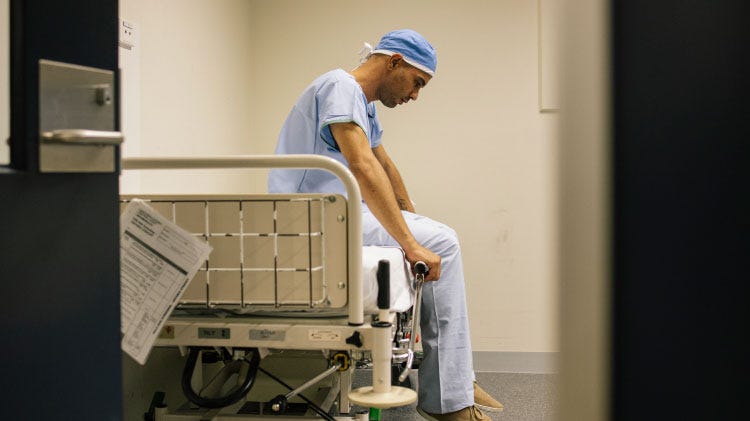
There’s a phenomenon in healthcare known as the second victim. I’ve experienced it a few times, actually. There was a cardiac arrest during my pediatrics rotation that still stays with me. For the days and weeks that followed, my mind turned over every possibility. What could I have done differently? What did I miss? I relived certain moments from that arrest over and over again. I'm writing this five years later, and there are words and facial expressions I can still see and hear as clearly as the day they happened.
I know this sounds strange, but fighting to keep that patient alive felt a lot like fighting for my own life. My nervous system was absolutely fried when we finally got the patient to the ICU.
I didn’t have a name for what I was experiencing. Now I do.
Medical Mindsets is written for the people inside medicine — the ones who give everything and rarely stop to examine what that costs. If that resonates, subscribe below. It's free.
What is second victim syndrome?
The term “second victim” was first described by Wu in 2000, who proposed that physicians who make mistakes also need help. More recently, an international consensus expanded the definition: a second victim can be any healthcare worker — whether directly or indirectly involved in an adverse event, unintentional error, or patient-related injury — who is also negatively impacted by the experience.
The name itself is worth sitting with. The patient is the first victim. The provider — the one who showed up to help, who may have done everything right, or who made a human error in an inhuman system — is the second.
Global estimates suggest that almost 50% of healthcare providers experience second victim syndrome at least once in their career. In intensive care settings specifically, 58% of ICU healthcare workers have experienced it, with frequent symptoms including guilt, anxiety, anger at self, and lower self-confidence.
This is not rare. This is the norm. And most of us suffer through it in silence.
What it actually feels like
The research maps it in clinical terms, but if you’ve been through it, you know it’s messier than any framework can capture.
In the earliest stage, second victims experience emotional and cognitive overload — disorganized thoughts, self-reflection, and attempts to understand what happened, all while still managing a patient in crisis. What follows is a period of intrusive reflections: persistent thoughts of fear and guilt, a re-evaluation of the event, and an ongoing search for explanations.
The “what ifs” don’t stop when you leave the hospital. They follow you home, into your sleep, into the middle of ordinary moments when your mind suddenly pulls you back.
A systematic review of 18 studies involving nearly 12,000 healthcare providers found that troubling memories were the most prevalent symptom, reported by 81% of those experiencing second victim syndrome. Physical symptoms are common too — fatigue, tachycardia, hypertension, and muscle tension are all documented responses. The body keeps the score, even when the mind tries to move on.
Why we don’t talk about it
Healthcare workers often expect perfection from themselves, and societal opinions reinforce this expectation. Perfection will always be an elusive goal, even for this group of hard-working, self-sacrificing, and altruistic humans.
That expectation creates a culture where admitting you’re struggling feels like admitting failure — and in medicine, failure carries consequences that most professions never have to reckon with. Stigma is a well-documented barrier to healthcare workers receiving mental health support in any form. So we compartmentalize. We move on to the next patient. We perform competence while quietly carrying weight that has nowhere to go.
An organizational culture of blame and a lack of support can intensify the provider’s suffering. Many of us trained in environments where debriefing after a difficult case meant a brief conversation in the hallway, if anything at all.
Recovery — and what actually helps
Approximately 20% of individuals take more than a year to recover from second victim syndrome, or do not recover at all. That number should stop us in our tracks.
Research points to a few things that genuinely help. During the stage in which a provider questions their acceptance in the workplace, encouragement from a peer or mentor can be the foundation for recovery. Not a formal program. Not a hotline. A colleague who says, "I’ve been there." What you’re feeling makes sense.
Second victims, as they move through predictable stages of recovery, can be positively influenced by a supportive organizational culture and the compassionate actions of peers, managers, and senior leaders. The research also outlines a framework for what affected providers deserve — summarized by the acronym TRUST: Treatment that is just, Respect, Understanding and compassion, Supportive care, and Transparency and opportunity to communicate.
Most of us never received any of that. We were expected to absorb it and keep going.
What I want you to take from this
If you’re a healthcare worker who has carried a case home — who has replayed a decision at 2am, who has felt personally diminished by an outcome you couldn’t control — you are not alone, and you are not broken.
You are a second victim of a system that asks everything of its people and rarely asks how they’re doing afterward.
Name it. Find one person you trust and tell them. And if someone in your orbit is struggling after a difficult case, don’t wait for them to ask for help. Show up. That single act is, according to the research, one of the most powerful things you can do.
We got into this to take care of people. That includes each other.
If this piece made you think of a colleague who's been carrying something heavy, forward it their way. Sometimes the most useful thing is simply knowing there's a name for what you're feeling.
Further reading
Wu, A.L. (2000) — the original paper that named the second victim phenomenon. Worth reading if you want to understand where this all started. (BMJ)
“Second Victim Syndrome in ICU Healthcare Workers” — a 2023 meta-analysis with some of the most current prevalence data. (PLOS One)
“Second Victim Syndrome: Interventions and Outcomes” — a 2025 systematic review on what actually helps. (PMC)
Twenty years ago, I lost a five week old to meningococcemia. (Well, she passed when she got to the tertiary care center, but, still.) We were fortunate to have a hospital team debrief and a clinic team debrief. Unfortunately, the hospital team debrief was a disaster. Suffice it to say that most of us didn't feel cared for. The clinic debrief, on the other hand, was excellent. We were able to go through the process of what went right (getting the baby seen immediately, escalating care from NP to MD) and what could have gone better and how we were managing our emotions. I still think of that case all these years later, even though I'm no longer practicing medicine.
Thank you for your candid story and telling of the prevalence of the second victim phenomenon.
It raises awareness. I worked as a medical assistant in my 20s, and that experience has benefitted me in so many ways over the years.
One, being the fact that doctors are like everyone else—human—but the stakes are higher when you have a bad day—and you likely have to keep it contained so much of the time, whereas others of us can talk about emotions and stresses—you have to carry the heavy decision-making and heartbreak.
I hope your article helps people extend generosity of spirit to their doctors and other medical professionals.
Best to you, Dr. Joe!